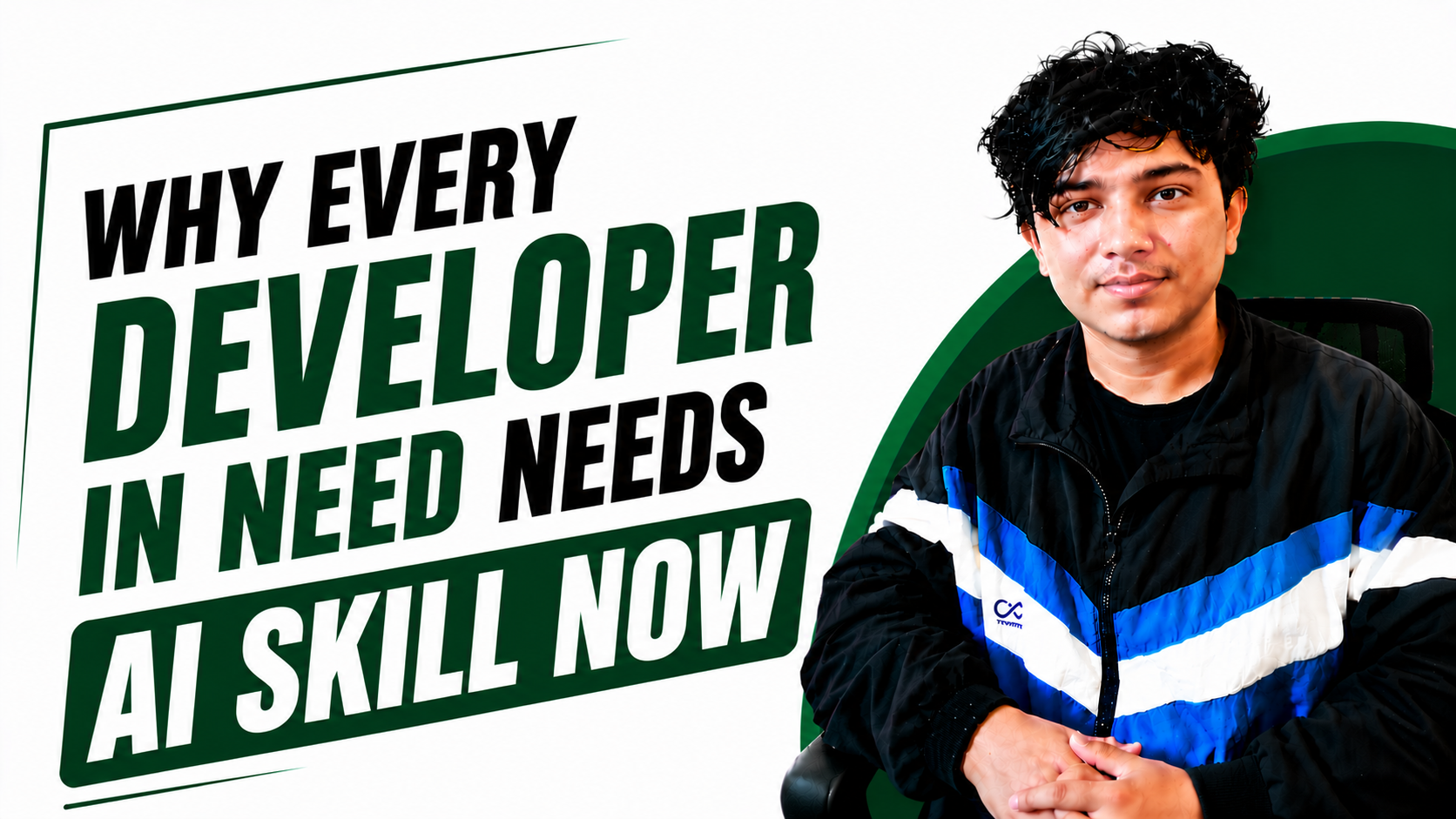
Why Every IT Professional in Nepal Needs AI Skills in 2026: Upskill or Get Left Behind
The tech landscape across Nepal’s primary digital hubs—from Lalitpur to Kathmandu—is undergoing a fundamental architectural pivot. For over a decade, building a sustainable tech career locally meant mastering standard full-stack web frameworks, mobile applications, or handling standard quality assurance processes. While those roles formed the bedrock of our software ecosystem, the standard engineering rules have changed.
The integration of automated engineering workflows, cognitive API layers, and predictive models has shifted data handling from an experimental niche into an absolute baseline requirement. Today, staying competitive in the local or remote tech market requires moving beyond static code structures into dynamic, data-driven systems.
The Global and Local Market Reality: Coding Alone Is No Longer Enough
The widespread adoption of large language models and code-generation engines means that basic, repetitive programming tasks are becoming increasingly automated. Standard boilerplate setups, routine HTML layouts, and basic debugging pipelines can now be handled by automated interfaces in seconds.
As a direct result, tech teams in Nepal and international remote employers are changing what they look for when hiring developers. They are no longer seeking individuals who only know how to translate pre-defined business parameters into basic loop logic. Instead, they are actively hunting for AI-augmented engineers—professionals who know how to clean complex data, structure machine learning pipelines, manage semantic searches, and deploy intelligent API infrastructures.
Three Compelling Reasons to Shift Your Tech Focus Natively
If you are an active web developer, QA analyst, or system administrator, adding data intelligence to your toolkit is the single most effective way to accelerate your career growth:
1. Exponential Salary Leverage and Remote Market Access
The shortage of qualified data and machine learning talent in Nepal means that engineers with verified model deployment capabilities command premium salaries. While standard full-stack development spaces face growing saturation, professionals who confidently navigate data manipulation frameworks see significantly stronger market leverage and higher starting offers from both local FinTech hubs and global remote clients.
2. Transitioning from Maintenance to System Architecture
Instead of spending your career handling routine maintenance, fixing frontend bugs, or writing repetitive test scripts, learning AI lets you tackle core system design challenges. You will learn to design predictive scoring systems, optimize internal enterprise search engines, and build automated backend infrastructures that directly impact a company's bottom line.
3. Future-Proofing Your Career Longevity
Technologies and frameworks change constantly, but foundational data management principles remain consistent. By mastering vector representations, data cleaning workflows, and probabilistic modeling, you build a versatile, long-term technical foundation that keeps you valuable no matter how programming languages evolve.
The Minimum Viable AI Toolkit for Developers
Upskilling does not mean throwing away your existing software experience. It means wrapping your current logic skills around a modern data science stack:
- Data Processing Foundations: Transitioning from basic scripting to handling structured matrix computations and advanced operations using libraries like NumPy and Pandas.
- Classical Predictive Logic: Understanding how statistical classifiers, regression lines, and decision frameworks process raw feature variables via Scikit-Learn.
- Deep and Generative Integration: Learning to implement artificial neural networks and build context-aware systems using modern vector databases and orchestrators.
- Production Deployment Pipelines: Mastering version control via Git and GitHub, formatting robust data pipelines, and wrapping models cleanly inside fast, production-grade web services using FastAPI.
Conclusion: Take the Leap
The technology shift is moving quickly, but the entry barrier has never been more manageable for determined learners. The future of software engineering does not belong to automated tools; it belongs to the developers who know how to build, manage, and scale them. Focus on building hands-on skills, expand your technical toolkit, and start creating the smart systems driving tomorrow's technology today.
🚀 Future-Proof Your Tech Career via AI Udaan
Do not let traditional software boundaries limit your professional growth. The AI Udaan Bootcamp by Digital Pathshala delivers an intensive, 16-week job-oriented curriculum covering Python, NumPy, Pandas, Machine Learning, Deep Learning, and Generative AI frameworks. Build a compelling, production-ready public GitHub portfolio backed by active local industry mentors for an accessible investment of just Rs. 5,000.
🔗 Review the Technical Modules & Secure Your Seat in AI Udaan Today!